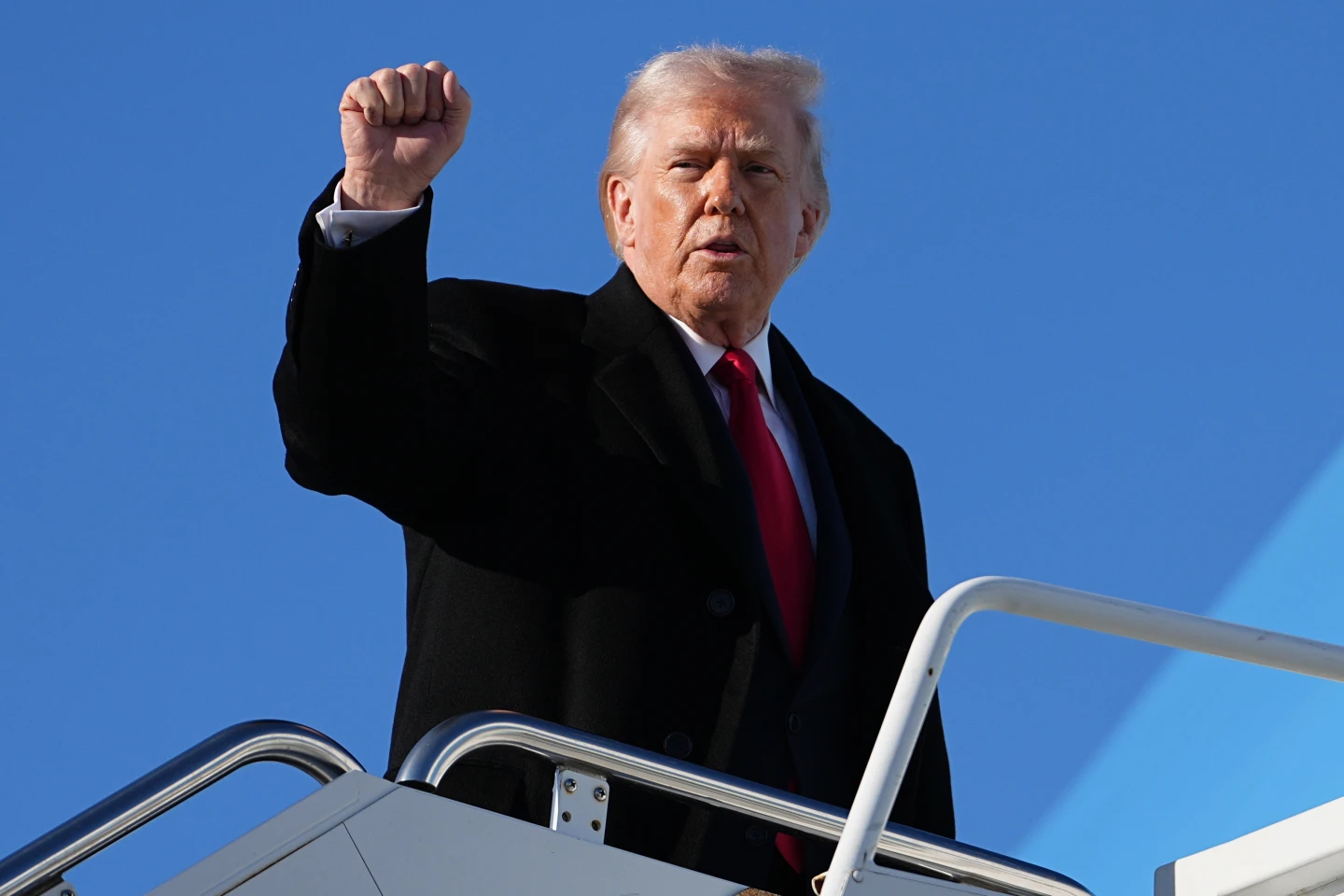
WASHINGTON — President Donald Trump remarked on Friday that a change in power in Iran "would be the best thing that could happen." This comes as the U.S. government is considering whether to use military force against Tehran.
Trump said this right after visiting troops at Fort Bragg, North Carolina, and after he said earlier in the day that he was sending a second aircraft carrier group to the Middle East.
When reporters pressed Trump about pushing for the end of Islamic clerical authority in Iran, he answered, "It seems like that would be the best thing that could happen." "They've been talking and talking and talking for 47 years."
In the past several weeks, the president has said that his main goal is for Iran to cut back on its nuclear program even more. However, on Friday, he said that this is just one of the things the U.S. needs Iran to give up.
Benjamin Netanyahu, the Prime Minister of Israel, went to Washington this week to negotiate with Trump. He has been pushing for any deal to include actions to stop Iran's ballistic missile program and stop backing groups like Hamas and Hezbollah that act as proxies for Iran.
Trump added that going after Tehran's nuclear program, which suffered big losses in U.S. military attacks last year, would be "the least of the mission."
Iran has always said that its nuclear program is for peaceful purposes. Before the battle in June, Iran had been enriching uranium to 60% purity, which is only a short, technical step away from weapons-grade levels.
Just a few weeks after Secretary of State Marco Rubio said that a change in power in Iran would be "far more complex" than the administration's recent effort to remove Venezuelan President Nicolás Maduro from office, Trump made comments calling for an end to Ayatollah Ali Khamenei's rule.
Last month, during a Senate hearing, Rubio said that Iran had "a regime that's been in place for a very long time."
Rubio stated, "So if that ever happens, it will take a lot of careful thought."
Trump announced that the USS Gerald R. Ford, the world's largest aircraft carrier, is being moved from the Caribbean Sea to the Middle East to join other U.S. warships and military assets that are already there.
Trump had said that there would be another round of discussions with the Iranians this week, but those meetings didn't happen because one of Tehran's senior security officers went to Oman and Qatar and sent communications to U.S. intermediaries.
Trump told reporters of the second carrier, "We'll need it in case we don't make a deal." He also said, "It will be leaving very soon."
Gulf Arab countries have already said that any attack may lead to new confrontation in the region, which is still recovering from the Israel-Hamas war in the Gaza Strip. Meanwhile, Iranians are starting to attend 40-day mourning ceremonies for the hundreds who died in Tehran's brutal crackdown on rallies across the country last month. This adds to the internal strain on the Islamic Republic, which is already feeling the effects of sanctions.
The latest York Times was the first to report on the Ford's latest deployment. It will join the USS Abraham Lincoln and its guided-missile destroyers, which have been in the area for more than two weeks. Last week, on the same day that Iran sought to stop a U.S.-flagged ship in the Strait of Hormuz, U.S. Marines shot down an Iranian drone that was getting close to the Lincoln.
Trump nonetheless gave reporters some hope on Friday that a deal could be reached with Iran.
Trump suggested that the U.S. may avoid military action if they "give us the deal that they should have given us the first time." "We won't do that if they give us the right deal."
Ford had been part of Venezuela strike force
The Ford would get there quickly. Trump sent it from the Mediterranean Sea to the Caribbean last October while the US built up a large military presence in the area before the surprise operation last month that caught Maduro.
It also seems to go against the Trump administration's national security and defense plans, which focus more on the Western Hemisphere than on other parts of the world.
When asked about the Ford's movement, U.S. Southern Command said that U.S. forces in Latin America will keep "countering illicit activities and malign actors in the Western Hemisphere."
Colonel Emanuel Ortiz, a spokesman for Southern Command, said in a statement, "Even though our force posture changes, our operational capability does not." "U.S. forces are still fully prepared to show strength, protect themselves, and protect U.S. interests in the region."
The Ford strike group will send more than 5,000 extra troops to the Middle East, but it won't bring many new weapons or capabilities that the Lincoln group doesn't already have. Having two carriers will give Trump and military strategists twice as many planes and weapons to work with.
Because the Ford is now in the Caribbean, it will probably be weeks before it gets to Iran's shore.
Trump has repeatedly threatened to use force to make Iran agree to limit its nuclear program and to punish Tehran for its violent response to protests across the country.
A week ago, Iran and the US talked to each other indirectly in Oman. After that, Trump told Tehran that if they didn't strike an agreement with his government, it would be "very traumatic." Last year, similar talks fell up in June when Israel started a 12-day war on Iran that included U.S. bombing of Iranian nuclear targets.
Long carrier deployments affect crews and ships
The USS Ford, on the other hand, left port for the first time in late June 2025, therefore the crew will have been on duty for eight months soon. It's not certain how long the ship will stay in the Middle East, but this relocation means the crew will be on deployment for a lengthy time.
Adm. Daryl Caudle, the Navy's senior officer, told reporters last month that keeping the Ford at sea longer would be "highly disruptive" and that he was "a big non-fan of extensions."
Carriers are usually sent out for six or seven months. "When it goes past that, it messes up lives, it messes up things... funerals that were planned, marriages that were planned, babies that were planned," Caudle added.
He stated that extending the Ford would make it harder to keep up with repairs and maintenance since it would throw off the schedule for repairs, add additional wear and tear, and increase the number of things that need to be fixed.
In 2023 and 2024, the aircraft carrier USS Dwight D. Eisenhower spent nine months in the Middle East, mostly fighting the Iran-backed Houthi rebels in Yemen. The ship went into repair on schedule in early 2025, however it missed its anticipated completion date of July and is still in the shipyard today.
In a recent interview with The Associated Press, Caudle said that his goal is to use smaller, modern ships instead of always relying on massive aircraft carriers.