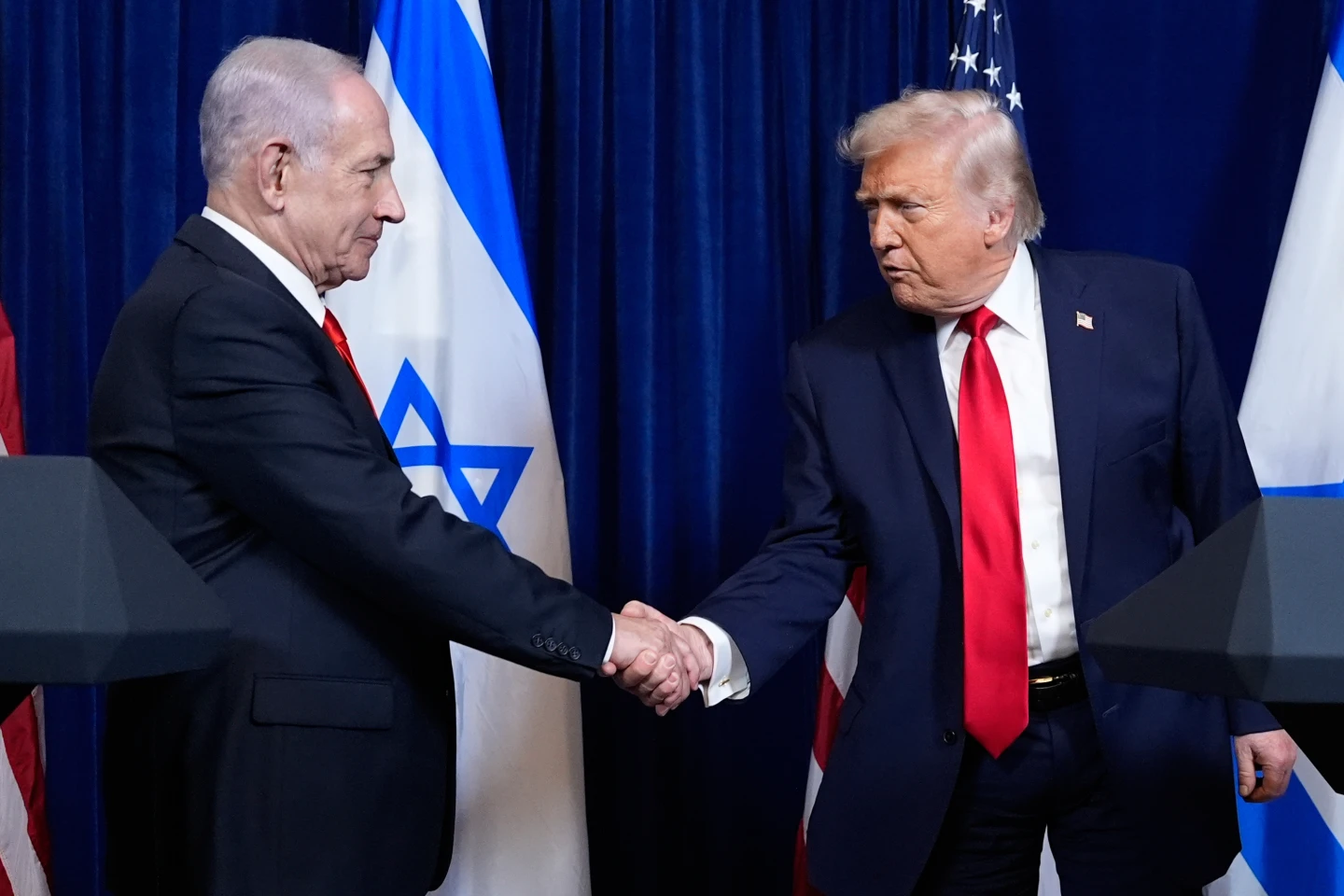
WASHINGTON — President Donald Trump met privately with Israeli Prime Minister Benjamin Netanyahu on Wednesday and said he’d insisted that negotiations with Iran continue as the U.S. pushes for a nuclear deal with Tehran.
Heading to Washington to meet with US President Donald Trump, Israeli Prime Minister Benjamin Netanyahu on Tuesday said he will present the American leader with Israel’s “principles” regarding negotiations with Iran.
“If it can, I let the Prime Minister know that will be a preference,” Trump wrote. “If it cannot, we will just have to see what the outcome will be.”
He added, “Last time Iran decided that they were better off not making a Deal” and were hit by U.S. airstrikes.
“Hopefully this time they will be more reasonable and responsible,” Trump wrote.
In a statement, Netanyahu’s office said the two leaders had discussed negotiations with Iran as well as developments in Gaza and around the region and they had “agreed to continue their close coordination and relationship.”
Wednesday’s meeting was their seventh during Trump’s second term and took place as both the U.S. and Iran are projecting cautious optimism after holding indirect talks in Oman on Friday about how, once again, to approach negotiations over Iran’s nuclear program.
Trump said on reaching an agreement with Iran in a Tuesday interview with Fox Business Network’s Larry Kudlow: “I think they’d be foolish if they didn’t. We took out their nuclear power last time, and we’ll have to see if we take out more this time.”
“It’s got to be a good deal,” he said then. “No nuclear weapons, no missiles.”
Netanyahu pushes for more in Iran talks
Before the meeting, Netanyahu's office said that he wanted the discussions between the U.S. and Iran to include constraints on Tehran's ballistic missile program and its backing for militant groups like Hamas and Hezbollah.
Netanyahu said before leaving Israel on Tuesday, "I will tell the president what we think about the principles of these negotiations. These are the most important principles for Israel and for everyone else who wants peace and security in the Middle East."
But it's still not certain how much Netanyahu will be able to change Trump's stance on Iran. At first, Trump threatened to use military force against Iran because of its violent response to protesters across the country in January. In the past several weeks, however, he has been trying to get Tehran to agree to a deal with its nuclear program through pressure.
The 12-day conflict with Israel in June still has Iran shaken up. The terrible series of bombings, which included the U.S. bombardment of several Iranian nuclear sites, killed about 1,000 people in Iran and almost 40 in Israel.
Trump has declared many times that U.S. attacks had "obliterated" Iran's nuclear capabilities, although it's not clear how much damage was done. Recent satellite photographs of nuclear installations show activity, which has raised concerns that Iran may be trying to fix or assess damage at the sites.
Israel has been asking Iran for a long time to stop enriching uranium, cut back on its ballistic missile program, and stop working with militant groups in the area. Iran has always said no to those requests, stating it would only agree to modest curbs on its nuclear program if the sanctions were lifted.
Washington has sent more military forces to the area, including an aircraft carrier, guided-missile destroyers, air defense capabilities, and more. Arab and Islamic countries, like Turkey and Qatar, have been asking both sides to calm down, saying that any attack or reprisal may make things worse in a region that is already tense because of the Israel-Hamas war in Gaza.
Gaza was also a topic
Trump wrote that he and Netanyahu "also talked about the great progress being made in Gaza and the region as a whole."
Next week, Trump will conduct the inaugural meeting of his Board of Peace. This board was originally meant to monitor the next steps of the U.S.-brokered Gaza ceasefire plan, but it has grown to include Trump's goals of fixing other global problems.
Netanyahu met with Secretary of State Marco Rubio in Blair House, which is across the street from the White House, earlier on Wednesday. They decided that Netanyahu would serve on the board.
Trump claimed on Friday that his special envoy Steve Witkoff and son-in-law Jared Kushner had "very good" meetings about Iran and that more were planned for this week. But the Republican president kept up the pressure, saying that "the consequences are very steep" if Iran doesn't reach a deal about its nuclear program.
Abbas Araghchi, Iran's foreign minister, said something similar, indicating that there would be talks about "next steps." He also added that the amount of distrust between the two long-time enemies is still a "serious challenge facing the negotiations."
He made it clear that Iran would stick to its position that it has to be allowed to enrich uranium, which is a big issue for Trump.
Netanyahu spoke with Witkoff and Kushner soon after he got to Washington on Tuesday night. The prime minister's office claimed they told him what happened in the negotiations with Iran in Oman.
In November, Araghchi indicated that Iran was no longer enriching uranium since the conflict previous year had caused too much damage.
Before the war, Iran was enriching uranium to 60% purity, which is just a short technical step away from weapons-grade levels. The International Atomic Energy Agency, which is in charge of nuclear safety for the U.N., declared that Iran was the only country in the world that could enrich uranium to that level without having the bomb.
Iran has turned down the IAEA's demands to look at the locations that were attacked during the June battle. Iran has limited IAEA inspections since Trump decided to pull the U.S. out of the 2015 nuclear deal with world powers on its own in 2018.