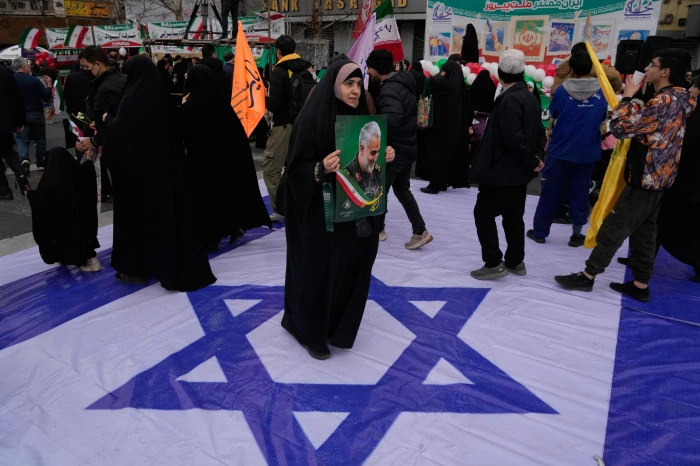
DUBAI, United Arab Emirates — Iran celebrated the 47th anniversary of its 1979 Islamic Revolution on Wednesday. The country's theocracy is still under pressure from U.S. President Donald Trump, who suggested sending another aircraft carrier group to the Middle East, and from the public, who are angry about Tehran's violent response to nationwide protests.
The celebration was like a split-screen depiction of life in Iran. State media showed hundreds of thousands of people across the country attending pro-government rallies where American flags were burned and people yelled "Death to America!" The night before, fireworks paid for by the government lighted up the black sky, and many in Tehran's homes yelled "Death to the dictator!"
At the same time, President Masoud Pezeshkian spoke at Azadi Square in Tehran and said that Iran is open to talks about its nuclear program, even though talks with the U.S. are still in the works.
It's still unclear if the talks will work out, and countries in the Middle East are worried that they might not, which could lead to another regional war. On Wednesday, a high-ranking Iranian security official met with Qatar's foreign minister in Doha. This was after the person had already been to Oman, which has been the mediator in this round of talks. Just before the official’s arrival, Qatar’s ruling emir received a phone call from Trump.
Pezeshkian claimed in his statement at the anniversary ceremony that Iran was "not seeking nuclear weapons" and is "ready for any kind of verification." But for months, the International Atomic Energy Agency, the UN's nuclear watchdog, has not been able to check and confirm Iran's nuclear stockpile.
Pezeshkian stated, "The United States and Europe have built a high wall of mistrust with their past words and actions that makes it impossible for these talks to end." "At the same time, we are fully committed to talking with our neighbors about how to bring peace and stability to the area."
Commemoration overshadowed by crackdown
On Wednesday, Iranian state TV showed pictures of people all around the country going out into the streets to support the theocracy and its 86-year-old Supreme Leader Ayatollah Ali Khamenei. Some people denounced Reza Pahlavi, Iran's exiled crown prince, for advocating for protests against the regime.
"I am here to say that we will not stop supporting our leader and our country, even though the Americans and Israelis are becoming more threatening," said 43-year-old Reza Jedi.
There were Iranian missiles on exhibit, as well as pieces that they said were from Israeli drones that had been shot down. There were also fake coffins covered in the American flag, one of which had a picture of U.S. Navy Adm. Brad Cooper is in charge of the American military's Central Command, which is in charge of the Middle East.
There is a hard-line group of people in Iran who support the country's theocracy, including members of the powerful paramilitary Revolutionary Guard. Activists say that this group put down protests last month in a bloody crackdown that killed thousands and arrested tens of thousands.
Many Iranians go to pro-theocracy protests because they work for the government or because they want to enjoy the carnival atmosphere of a government-sponsored holiday. There are 2.5 million government workers in Iran, and one-fifth of them work in Tehran.
Pezeshkian didn't talk about the bloodshed explicitly, but he did say that the crackdown that started in earnest on January 8th had "caused great sorrow."
"We are ashamed in front of the people, and we have to help everyone who was hurt in these events," he stated. "We don't want to fight with the people."
One man regrettably stood on a curb in Tehran and watched the ceremony without taking part.
"I went to the rally every year before this one," said the man, who asked to remain anonymous out of fear of retaliation. "But how can I do that now that the streets were full of blood last month?"
A senior Iran official visits Qatar
As the commemoration took place, senior Iranian security official Ali Larijani met in Qatar with Foreign Minister Sheikh Mohammed bin Abdulrahman Al Thani. Qatar hosts a major U.S. military installation that Iran attacked in June, after the U.S. bombed Iranian nuclear sites during the 12-day Iran-Israel war. Larijani also met with officials of the Palestinian Hamas militant group, and in Oman with Tehran-backed Houthi rebels from Yemen.
Larijani told Qatar’s Al Jazeera satellite news network that Iran did not receive any specific proposal from the U.S. in Oman, but acknowledged that there was an “exchange of messages.”
Qatar has been a key negotiator in the past with Iran, with which it shares a massive offshore natural gas field in the Persian Gulf. Its state-run Qatar News Agency reported that ruling emir Sheikh Tamim bin Hamad Al Thani spoke with Trump about “the current situation in the region and international efforts aimed at de-escalation and strengthening regional security and peace,” without elaborating.
Speaking to the Russian state channel RT, Iranian Foreign Minister Abbas Araghchi said Tehran still does “not have full trust for the Americans.”
“Last time we negotiated, last June, we were in the middle of negotiation then they decided to attack us and that was a very, very bad experience for us,” Iran’s top diplomat said. “We need to make sure that that scenario is not repeated and this is mostly up to America.”
Despite that concern, Araghchi said it could be possible “to come to a better deal than Obama,” referencing the 2015 nuclear deal with world powers Iran reached when former U.S. President Barack Obama was in office. Trump in his first term unilaterally withdrew America from the accord.
Trump suggests sending another carrier to the Mideast
The U.S. has sent the aircraft carrier USS Abraham Lincoln, ships, and fighters to the Middle East to put pressure on Iran to reach an agreement. This gives Trump the option to attack Iran if he wants to.
U.S. troops have already shot down a drone that they said strayed too near to the Lincoln and helped a U.S.-flagged ship that Iranian soldiers sought to stop in the Strait of Hormuz, which is the small mouth of the Persian Gulf.
Axios, a news website, reported that Trump was thinking about sending a second carrier to the area. He said, "We have a fleet of ships going there, and another one might be going there too."
It's still not apparent which airline could go. The USS George H.W. Bush has left Norfolk, Virginia, according to the U.S. Navy Institute News. The USS Gerald R. Ford is still in the Caribbean after the U.S. military strike that took Venezuelan leader Nicolás Maduro.
During a trip to Baku, Azerbaijan, U.S. Vice President JD Vance indicated that the goal has been to reach a settlement through negotiations, but that alternative measures are still on the table if talks fail.
He remarked, "He's going to have a lot of choices because we have the strongest military in the world."