A federal judge said on Presidents Day, the federal holiday that honors Washington's legacy, that an exhibit on nine people who were enslaved by George Washington must be put back up at his old home in Philadelphia. The exhibit was taken down by President Donald Trump's administration last month.
In January, the city of Philadelphia sued the National Park Service for taking down the panels that explained the history of Independence National Historical Park. This is where George and Martha Washington resided with nine of their slaves in the 1790s, when Philadelphia was temporarily the capital of the United States.
The removal was done because of a Trump executive order to "restore truth and sanity to American history" at the country's museums, parks, and landmarks. It told the Interior Department to make sure that the places don't show anything that "inappropriately disparages Americans past or living."
On Monday, U.S. District Judge Cynthia Rufe said that all materials must be returned to their original condition while a case is going on that questions the constitutionality of the removal. She told Trump officials they couldn't put in new ones that tell the tale differently.
Rufe, who was appointed by Republican President George W. Bush, started her written order with a quote from George Orwell's dystopian novel "1984." She said that the Trump administration was like the book's totalitarian regime, the Ministry of Truth, which changed historical records to fit its own story.
Rufe wrote, "As if the Ministry of Truth in George Orwell's 1984 now existed, with its motto 'Ignorance is Strength,' this Court is now asked to decide if the federal government has the power it claims to have to change and break up historical truths when it has some control over historical facts." "It does not."
During a hearing in January, she told lawyers from the Justice Department that their claims that Trump officials can chose which aspects of U.S. history to show at National Park Service sites were "dangerous" and "horrifying."
The Interior Department didn't react right away to a request for comment on the ruling, which came when government offices were closed for the federal holiday.
The judge did not say when the exhibit had to be put back up. The decision can be appealed by federal officials.
The administration has secretly taken down information regarding the history of enslaved people, LGBTQ+ people, and Native Americans from the historical site and other sites.
Signs that are no longer there at Grand Canyon National Park declared that settlers pushed Native American tribes "off their land" so that the park could be built and "exploited" the land for mining and grazing.
Last week, a rainbow flag was torn down at the Stonewall National Monument, where bar patrons fought back against a police raid and started the contemporary LGBTQ+ rights movement. The administration has also taken down mentions of transgender persons from its webpage about the monument, even though several trans women of color were important leaders in the revolt.
Twenty years ago, the city of Philadelphia and the federal government worked together to make an exhibit that featured biographical information about each of the nine people who were enslaved by the Washingtons at their home, including two who escaped.
Oney Judge was one of them. He was born into slavery on the family's farm in Mount Vernon, Virginia, and escaped from their residence in Philadelphia in 1796. Judge ran away to New Hampshire, a free state, while Washington declared her a fugitive and put out ads asking for her to come back.
In 2022, the nationwide Park Service added Judge's house to a nationwide network of Underground Railroad locations. The government promised to "honor, preserve, and promote the history of resistance to enslavement through escape and flight."
Rufe noted that taking down content regarding Judge "hides important information that connects the site" to the network.
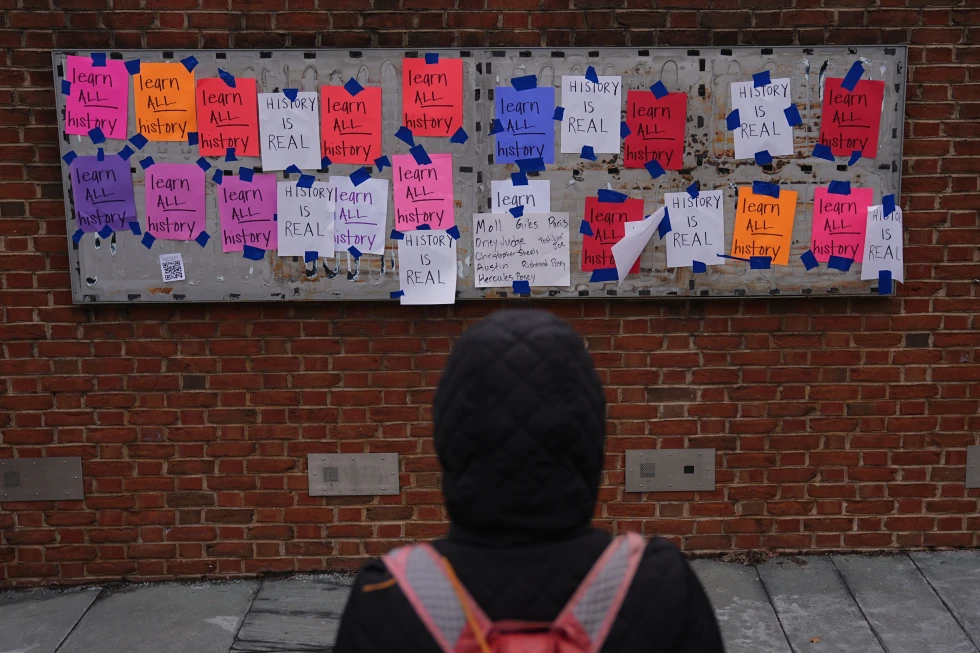
After government workers used a crowbar to break up the plaques on January 22, just the names of Judge and the other eight enslaved people—Austin, Paris, Hercules, Richmond, Giles, Moll, Joe, and Christopher Sheels—remained carved into a cement wall.
Hercules also got away in 1797 when he was taken to Mount Vernon, where the Washingtons had a lot of other slaves. He made it to New York City even though he was declared a fugitive slave. He resided there under the name Hercules Posey.
thousands local politicians and leaders in the Black community were happy with the decision, which occurred when thousands were at the site protesting for its restoration.
A Philadelphia Democrat and state representative, Malcolm Kenyatta, stated that the community won against an attempt by the Trump administration to "whitewash our history."
"Philadelphians fought back, and I'm so proud of how we all stood together," he said.