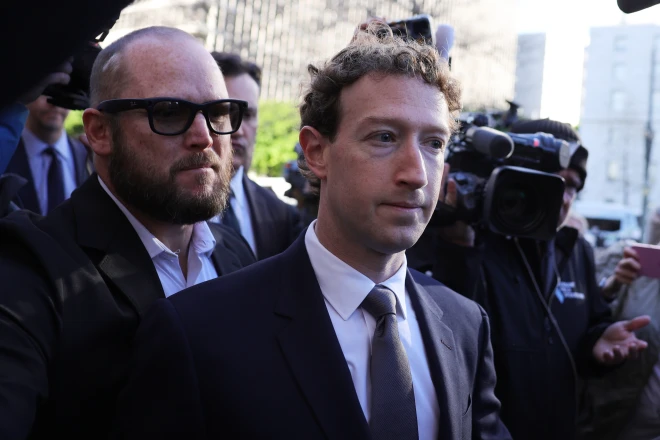
LOS ANGELES — On Wednesday, Mark Zuckerberg and lawyers on the other side fought in a Los Angeles courtroom. The Meta CEO faced questions about how teens use Instagram, his appearance in front of Congress, and advice he's had from inside the company about being "authentic" and not "robotic."
Zuckerberg's evidence is part of a one-of-a-kind social media trial that looks into whether Meta's platforms intentionally injure and addict kids. When asked by the plaintiff's lawyer, Zuckerberg stated that he still believes with what he said before: that there is no scientific evidence that social media impairs mental health.
Mark Lanier, the plaintiff's lawyer, asked Zuckerberg if people are more likely to utilize something if it makes them feel good.
Zuckerberg remarked, "I don't know what to say to that." "I don't think that fits here."
The plaintiff's lawyers say that the 20-year-old lady, whose initials are KGM, became addicted to social media when she was young and that it made her melancholy and suicidal ideas worse. Meta Platforms and Google's YouTube are the only two defendants left in the dispute, which TikTok and Snap have settled.
Lanier started his questions by giving three choices for what individuals can do with vulnerable people: help them, ignore them, or "prey upon them and use them for our own ends." Zuckerberg stated he agreed that the last alternative is not what a decent corporation should do. He said, "I think a reasonable company should try to help the people that use its services."
Lanier asked the Meta CEO a lot of questions about something he stated during a congressional testimony a while ago. He indicated that Instagram staff are not given goals to get consumers to spend more time on the site.
Lanier showed internal documentation that seemed to go against what he said. Zuckerberg noted that they used to have goals related to time, but he and the firm made the choice to stop working toward those goals and instead focus on usefulness. He said he believes in the "basic assumption" that "people will use something more if it is useful to them."
Lanier also asked Zuckerberg about what he called "extensive media training," which included things like presenting testimony in court. Lanier showed Zuckerberg an internal memo that said people didn't like the way he spoke on his own social media. It told him to be "authentic, direct, human, insightful, and real," and not to "try hard" or be "fake, robotic, corporate, or cheesy" in his communication.
Zuckerberg said that those who told him how to answer questions or portray himself were "just giving feedback" and that he had not been trained to do so.
Zuckerberg responded, "I think I'm actually well known to be sort of bad at this," when asked about his public speaking and media appearances.
People have made fun of the Meta CEO online for a long time because he looks robotic and, when he was younger, scared when he spoke in public. In 2010, during an interview with famous tech writers Kara Swisher and Walt Mossberg, he was so nervous that Swisher asked him if he wanted to "take off the hoodie" that he wore as a uniform at the time.
Lanier spent a lot of time with Zuckerberg asking about the company's practices on checking people's ages.
After a long back-and-forth, Zuckerberg remarked, "I don't see why this is so hard." He repeated that the company's policy limits users under 13 and that they work to find users who have lied about their ages to get around the rules.
Zuckerberg generally stuck to his talking points, emphasizing several times that he disagreed with Lanier's "characterization" of his questions or of Zuckerberg's own comments. He again talked about his goal of making a platform that is useful to people.
Zuckerberg was questioned on Instagram's policies on cosmetic beauty filters, just like Adam Mosseri, the head of Instagram, was last week. Zuckerberg said he didn't think there was enough proof that the filters may hurt people, and he claimed he has a "high bar" for blocking tools or features that would limit people's freedom of speech. Lanier said that all 18 of the outside experts Meta talked to about the filters and their possible effects raised concerns.
People who speak up for kids said Zuckerberg's testimony was not honest.
Josh Golin, executive director of Fairplay, stated, "All Mark Zuckerberg did with his testimony today was show that he can't be trusted, especially when it comes to keeping kids safe." Meta's CEO swore that his company did not want to get more people to spend time on Instagram. We know, though, that Zuckerberg and the other executives stopped Instagram from getting rid of features like visible like counts and plastic surgery filters, which are by their very nature addicting.
Zuckerberg has also given testimony in other courts and answered questions from Congress on how safe Meta's platforms are for kids. He said he was sorry to families whose lives had been turned upside down by catastrophes they thought were caused by social media during his 2024 congressional hearing. He did say he was "sorry for everything you have all been through," but he didn't take full responsibility for it. This is the first time Zuckerberg has been in front of a jury. Once again, parents who have lost a child are in the audience in the courtroom.
The case, along with two others, has been chosen as a bellwether trial. This means that the verdict could affect how thousands of other claims against social media corporations are likely to go.
Paul Schmidt, one of Meta's lawyers, said in his opening statement that the business does not deny that KGM had mental health problems. Instead, it argues that Instagram was not a major cause of those problems. He revealed medical records that suggested a troubled family life, and both he and a lawyer for YouTube said she used their sites as a way to deal with her mental health problems or to get away from them.
Last week, a different study for Meta started in New Mexico.