

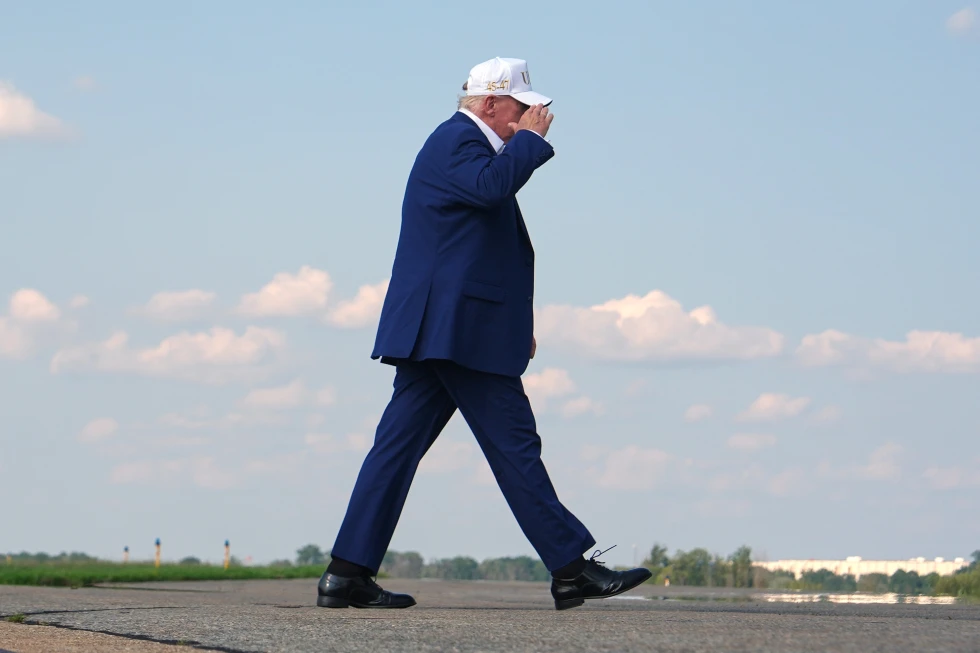
WASHINGTON — President Donald Trump loves to claim that he started his war with Iran after 50 years of economic pressure failed to stop its nuclear weapons ambitions — but he’s now betting another financial squeeze can end that conflict.
The Trump administration is banking on months of bombing pushing Iran’s economy to the breaking point and forcing its leadership to give in to demands to stop its nuclear program and completely reopen the Strait of Hormuz to oil and natural gas vessels.
The president on Monday claimed Iran is now seeking reparations as part of any peace discussions, and he plans to demand the same for the U.S. side. This is part of a broader Trump pivot this weekend to imply that Iran is now on the verge of financial implosion, despite already enduring decades of financial sanctions, which tend to be a longer-term play rather than an instant instrument of war that may stop a battle.
The move comes as U.S. stockpiles of vital weapons have shrunk and stop-start discussions seem to have stopped again. But Trump says the pressure can result in a breakthrough.
“They can cause trouble, but they’re broke,” Trump told reporters. They’re broke. Iran is broke, you know. Totally broke. And they’re not paying their troops. They have inflation at 300 percent.”
Iran’s inflation is significant, but Trump’s calculations were greater than what administration officials have told reporters. But the possibility of a lengthier war also entails inflation risks for other countries, particularly the U.S., where the war and increasing gasoline prices are unpopular.
Crude oil prices gained Monday, as investors read Trump’s remarks as an indication that fewer ships will be passing thru the Strait of Hormuz, continuing to restrict global supplies of gasoline, jet fuel, natural gas and other types of energy. Primarily, the Iran war locked off the canal that was responsible for shipping about 20 percent of the world oil supplies before the war -- and attempts to restore the strait have been short-lived as it has become a leverage point for the Iranians in negotiations.
Iran does not seem to be openly deterred by the threat of new financial penalties.
“Whenever Washington cannot pursue diplomacy, it resorts to sanctions; and whenever those sanctions fail to produce results, it simply increases the dose,” Iran’s Foreign Ministry spokesman Esmaeil Baqaei wrote on social media. “The real danger is that American politicians in thrall to this bad habit will choke off their remaining opportunities for a less humiliating exit from a crisis of their own making.”
The White House has dubbed it “Operation Economic Fury” The president did not specify what further financial pressure would be exerted, but since April 16 the administration has been engaged in what it calls “Operation Economic Fury” on Iran. Treasury Secretary Scott Bessent termed this the “financial equivalent” of a bombing campaign, saying countries that import oil from Iran or bank with it might be sanctioned.
The trouble with this turn, however, is that the sanctions can’t bite as fast as the impact of the partially sealed strait, said Richard Nephew, a senior research scholar at Columbia University who helped coordinate Iran sanctions strategy in the Obama administration.
Nephew emphasized that the efficacy of sanctions as a tactic is limited since Trump has not articulated clear strategic aims for the war, at times highlighting that it can’t have a nuclear weapon, then emphasizing the strait and then talking about ballistic missiles. Instead, Trump has unleashed a succession of tremendous air strikes and a level of destruction that has not achieved the swift end he predicted in the beginning.
“He’s not explained why, but it’s possible that economic pressure is part of his strategy,” Nephew added. “Trump has systematically undermined his own hand with his poor use of force, his clumsy explanation of an objective and his waffling on negotiations.
Yet the sanctions and the continuing U.S. naval blockade of Iranian ports give the U.S. economic and financial power, said Juan Zarate, a deputy national security adviser in the George W. Bush administration. “The U.S. sanctions threatening third-party countries doing business with Iran also have an effect,” Zarate said. But these things take time, he said.
“The critical question is whether the United States is willing to go so far as to strangle Iran’s oil trade, and to threaten third countries with severe sanctions — and whether it has the patience to see whether the economic pain will change the regime’s behavior,” Zarate added.
Sanctions had been employed by past presidents. Trump says they didn’t go far enough Trump’s recent move to economic issues with Iran is a bit of a flip-flop. Trump has long criticized previous administrations for using sanctions to limit Iran’s ability to pay for its military and nuclear projects. Defending the bombing, missiles and drone attacks that started on Feb. 28 in a speech last week in Las Vegas, he said the sanctions of past administrations that date back to November 1979 had not succeeded.
“It’s been 47 years, but actually it’s been 50 years because they’ve been saying 47 for three years, it’s been 50 years,” Trump remarked. "And no other president has done what you should have done a long time ago, because Iran can't have a nuclear weapon, can't have it."
The conflict has badly hit the Iranian economy, with the International Monetary Fund estimating the total GDP contracted by 5.4%. The Iranian government recently reported an annual inflation rate of 88.6%. The U.S. Treasury Department said average Iranian oil loadings had fallen to less than 500,000 barrels per day in the past month from 1.8 million barrels per day before the war.
The U.S., the world’s largest economy, has kept growing, but inflation is high and borrowing prices have risen in ways that have affected Trump’s popularity and led to rejection of the Iran conflict.
“It’s not just what the military can do, we’ve got the most powerful economy in the world as well,” Defense Secretary Pete Hegseth said Monday in a joint presentation with Bessent. “And when you have a motivated treasury secretary who can pull a lot of levers because he knows how to do it, you can put a lot of pressure on adversaries.”