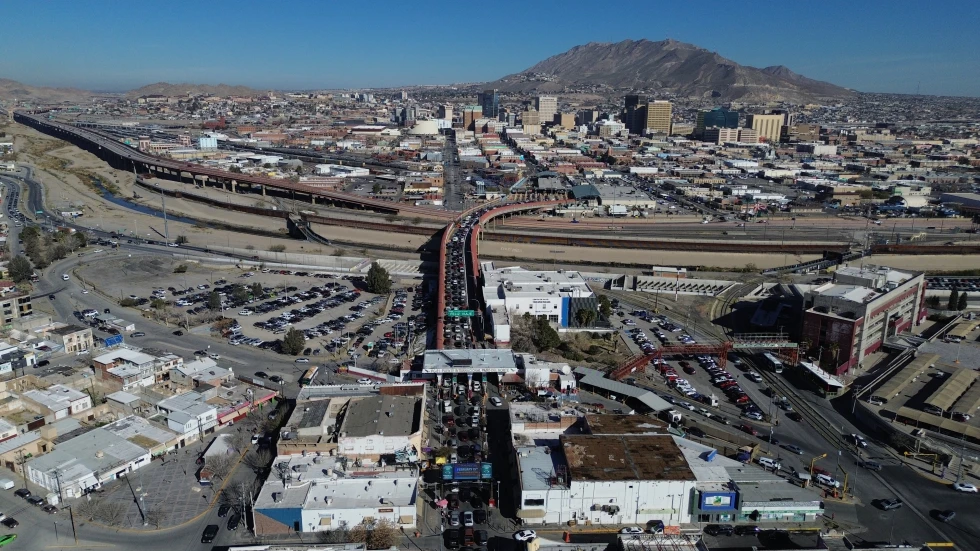
EL PASO, Texas — The Pentagon let U.S. Customs and Border Protection use an anti-drone laser earlier this week. This made the Federal Aviation Administration suddenly close the airspace over El Paso, Texas, on Wednesday, according to two people who know what happened but didn't want to be named because they were talking about sensitive information.
The FAA's announcement that all flights over the city on the U.S.-Mexico border would be canceled for 10 days caused some travelers to be stuck, although the restriction only lasted a few hours. The Trump administration stated it was because the FAA and Pentagon were trying to stop Mexican cartel drones from coming into the country. These drones are not uncommon along the southern border.
One of the people alleged that the laser was used near Fort Bliss without the FAA's permission. The FAA then opted to limit the airspace to protect commercial air travel. People who knew about the situation said that the technology was employed even though the Pentagon and the FAA were supposed to meet later this month to talk about it.
The restrictions didn't last long in the metropolis of almost 700,000 people, but it's not common for an entire airport to be down, even for a short time. Travelers who were stuck with their bags lined up at airline ticket booths and auto rental desks before the order was lifted.
After seven arrivals and seven departures were canceled, normal flights started again. Some medical evacuation flights also had to be changed.
Their morning flight from Las Cruces, New Mexico, to Portland, Oregon, was canceled, so Jorge Rueda, 20, and Yamilexi Meza, 21, were missing part of their Valentine's Day weekend trip.
Rueda said he was happy that "10 days turned into two hours." They had a flight out of El Paso in the evening.
A troubling lack of coordination
The investigation into the crash between an airplane and an Army helicopter outside Washington, D.C., last year that killed 67 people showed that the FAA and the Pentagon didn't always operate well together.
According to the National Transportation Safety Board, the FAA and the Army did not communicate safety information with each other about the several near misses at Reagan National Airport and did not deal with the hazards.
Senator Tammy Duckworth, a Democrat from Illinois and a former Army helicopter pilot who works on committees that deal with aviation and the military, said on Wednesday that the incident was another example of "the lack of coordination that’s endemic in this Trump administration."
Ted Cruz, R-Texas, is the chairman of the Senate Commerce Committee. He said he will ask the FAA for a briefing on what happened.
Democratic Rep. Veronica Escobar, whose district includes El Paso, claimed that neither her office nor local officials were told ahead of time that the closure would happen. She remarked, "The information coming from the federal government doesn't add up" when it was lifted.
Escobar stated during a news conference, "I think the FAA owes the community and the country an explanation for why this happened so quickly and without warning and was lifted so quickly and without warning."
Transportation Secretary Sean Duffy stated earlier that the airspace was blocked because the Defense Department and the FAA stopped Mexican cartel drones from entering and "the threat has been neutralized."
Officials from the Department of Homeland Security, the FAA, and the Department of Transportation did not react right away when asked for comments. A Trump administration official said that the agencies were all working together to preserve national security and pointed to Duffy's statement. The Pentagon stated it had nothing more to say than what it had already said, which was largely the same as what Duffy said.
Republican Rep. Tony Gonzales, whose congressional district encompasses a region along Texas' border with Mexico that is nearly 800 miles (1,300 kilometers) long, said that cartel drones are often seen.
"For those of us who live and work near the border, it's normal for criminal groups to send drones across the border every day." Gonzales replied, "It's a Wednesday for us."
In July, Steven Willoughby, the deputy director of the Department of Homeland Security's counter-drone program, told Congress that drug traffickers use drones almost every day to move drugs across the border and keep an eye on Border Patrol agents. He stated that more than 27,000 drones were seen inside 500 meters (1,600 feet) of the southern border in the last six months of 2024, primarily at night.
A former chief security officer at United Airlines says that closing an entire airport because of a security problem is "extremely rare."
Rich Davis, a senior security advisor at risk mitigation consultancy International SOS, said that officials normally try to take steps to isolate the risk if a specific jet or airline is threatened instead of shutting down the airport.
Mexican officials question the explanation
When asked about the U.S. government's explanation of the drone, Mexican President Claudia Sheinbaum responded, "I don't know anything about the use of drones on the border." She said that if the U.S. government has further information, they should get in touch with Mexico's administration.
Sheinbaum told reporters that the Mexican defense and navy secretaries were going to meet with officials from U.S. Northern Command on Wednesday in Washington, D.C. The meeting would also include officials from other countries. Sheinbaum added that the Mexican officials would "listen" at the conference and that her administration will look into "the exact causes" of the shutdown.
Along with Ciudad Juárez, El Paso is a center for trade across the border. The metropolis in Mexico has around 1.5 million people living there, and some of them are used to using airports and other amenities on the U.S. side of the border.
Juarez is particularly appealing to Mexico's drug gangs because it's simple to get to the United States. They want to protect their smuggling routes for drugs and people going north and cash and firearms going south.
‘This was a major and unnecessary disruption’
Mayor Renard Johnson of El Paso informed reporters that he didn't know about the shutdown until after the alarm was sent out.
Johnson added, "Making decisions without notice and coordination puts lives at risk and makes things more dangerous and confusing." "This was a big and unnecessary disruption that hasn't happened since 9/11."
The airport calls itself the "gateway" to southern New Mexico, northern Mexico, and west Texas. Southwest, United, American, and Delta are some of the airlines that fly there.
There was a similar 10-day temporary aircraft ban around Santa Teresa, New Mexico, which is roughly 15 miles (24 kilometers) northwest of the El Paso airport, for unique security considerations. Officials from the FAA didn't say right away why that limitation was still in place.
Senator Ben Ray Lujan, a Democrat from New Mexico, said in a statement that he was asking the FAA and the Trump administration "why the airspace was closed in the first place without notifying the right people, leaving travelers to deal with unnecessary chaos."
Confusion for travelers
Plans to travel on both sides of the border were messed up.
On Wednesday morning, María Aracelia was lugging two roller bags across the pedestrian bridge that connects Ciudad Juarez and El Paso. She was supposed to fly to Illinois and back in the afternoon.
She got a text at 4 a.m. notifying her the airport would be closed for 10 days, and she rushed to research other choices, including how to get to another airport. After then, there was a message saying that the El Paso airport was open again.
Aracelia stated, "This is stressful, and there isn't enough time to make so many changes, especially if you need to get back to work."