


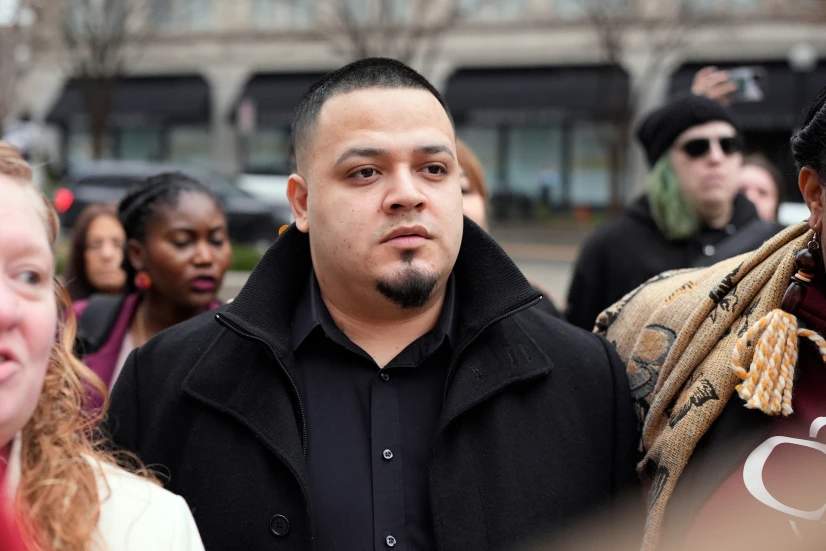
A federal court on Friday threw out a human smuggling case against Kilmar Abrego Garcia, saying the Justice Department’s decision to bring criminal charges was a ploy to punish him for fighting his wrongful deportation to El Salvador last year.
The ruling was a stunning rebuke to a Justice Department that under President Donald Trump has been regularly accused of trying to target individuals for political reasons. The accusations against Abrego Garcia were trumpeted by the Trump administration last year at a press conference when then-Attorney General Pam Bondi said, “This is what American justice looks like.”
“The evidence before this court unfortunately shows an abuse of prosecuting power,” U.S. District Judge Waverly Crenshaw of Nashville, Tenn., said in his judgment allowing Abrego Garcia’s petition to dismiss for “selective or vindictive prosecution.” However, “but for Abrego Garcia’s successful lawsuit challenging his removal to El Salvador, the government would have not brought this prosecution.”
Abrego Garcia’s deportation was an embarrassment to Trump officials when they were ordered to send him back to the U.S. Abrego Garcia said in his move to dismiss that the prosecution was vindictive, pointing to the timing of the criminal charges and inflammatory remarks about him by key Trump officials.
His future in the United States is uncertain despite the win in criminal court. Administration officials have threatened to deport him to a string of African countries, the latest being Liberia, after being blocked from deporting him to El Salvador.
“Kilmar Abrego Garcia is a victim of a politicized, vindictive White House and its lawyers at what used to be an independent Justice Department,” his criminal defense counsel said in a statement after Friday’s ruling. “We’re so happy that he is a free man.”
The Justice Department promised to challenge the judge's ruling, which it called "wrong and dangerous."
Crenshaw stopped short of finding the government acted with “actual vindictiveness,” a rarely met requirement that often requires evidence such as a prosecutor admitting charges were brought in retaliation against someone. But the judge did find there was enough evidence of "presumptive vindictiveness" -- including the timing of the indictment, statements made by then-U.S. Deputy Attorney General Todd Blanche, and the sustained oversight of the case by other top Justice Department officials -- that the case against Abrego Garcia was thoroughly tainted.
Crenshaw said the government’s explanations themselves were not convincing.
Abrego Garcia was charged with human smuggling and conspiracy to commit human smuggling and prosecutors said he took money to move people in the United States who were in the country illegally.
The allegations are related to a 2022 traffic stop in Tennessee for speeding. A Tennessee Highway Patrol trooper’s body camera video shows him calmly talking with Abrego Garcia. There were nine people in the car and the officers talked between themselves their suspicions of smuggling But finally, Abrego Garcia was permitted to go on driving with just a warning.
The timing of the charges was key to the presumption of vindictiveness, Crenshaw wrote in his ruling Friday. Homeland Security knew about the traffic stop for two years and had closed its case against Abrego Garcia when it sent him away. The case was reopened after the U.S. Supreme Court declared that he had to be returned to the U.S. The government had the burden of overcoming the presumption of vindictiveness, but the prosecutors did not bring in the person who reopened the case to explain why. Instead they awarded just “hearsay evidence.”
Abrego Garcia thanked God for the dismissal of the criminal accusations in a statement posted by the NGO We are CASA, which has been supporting him and his family.
“Justice is a big word and even bigger promise to keep and I am grateful that today justice has taken a step forward,” he said.
Abrego Garcia’s deportation defied a 2019 immigration court decision protecting him from being sent to his native country where a gang that targeted his family posed a danger. Abrego Garcia is a Salvadoran citizen who’s lived in the U.S. for years with his American wife and child, but entered the country illegally as a teenager. The 2019 ruling had enabled him to remain in the U.S. and work under Immigration and Customs Enforcement monitoring, but he was not granted residence status.