
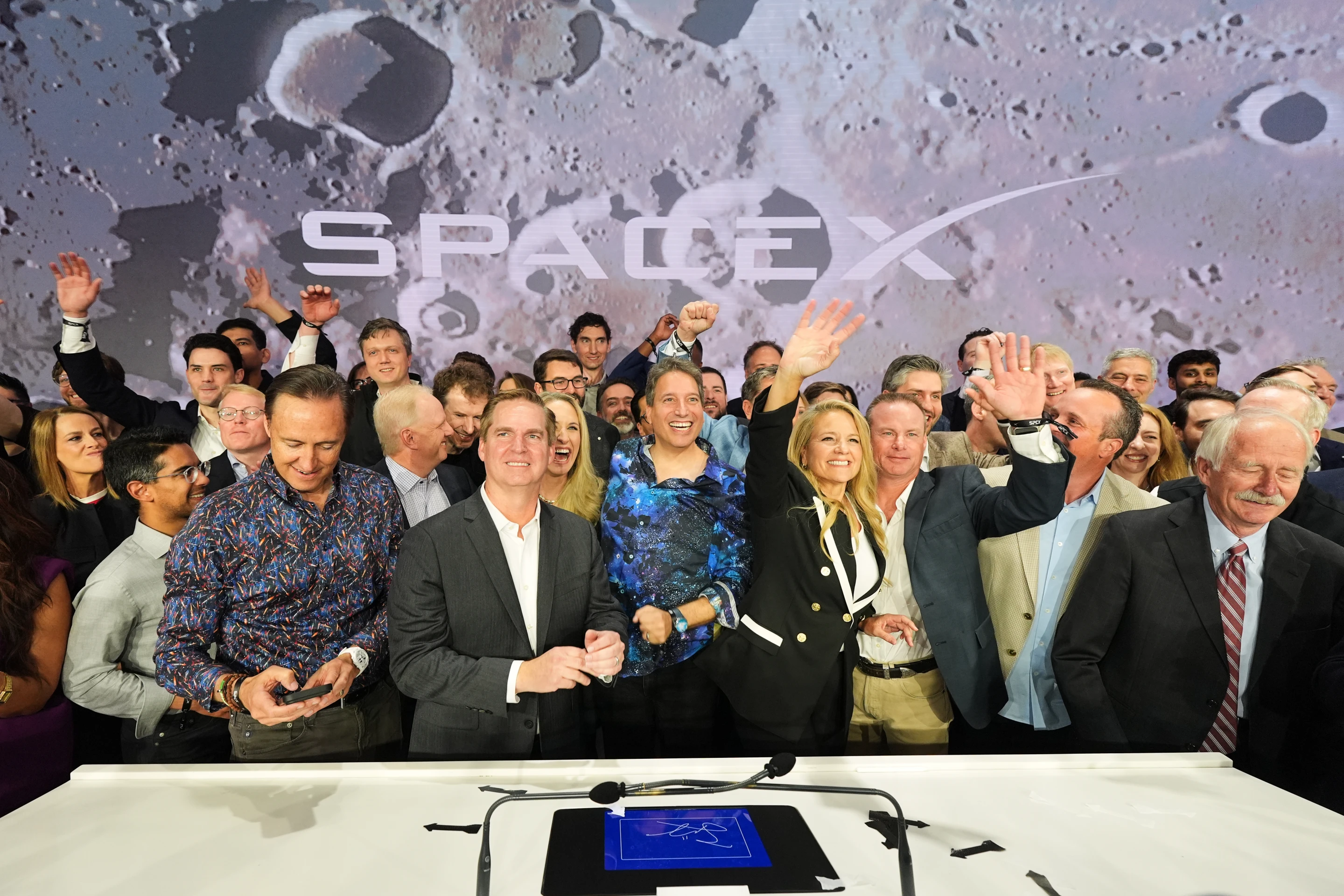
NEW YORK — SpaceX shares soared over 19% when it opened for trade on Friday, a sign investors are looking beyond the billions the firm is losing and instead hoping its huge investments in satellites, orbital data centers and artificial intelligence will pay off in the future.
Shares in SpaceX opened around noon at about $150 apiece, climbed to about $168 and closed the day just shy of $161. The pricing valued the company at $2.1 trillion, making it the sixth largest public U.S. company – bigger even than electric vehicle maker Tesla, the other main business of its founder and CEO.
Musk, who is also CEO of Tesla and owns a stake in SpaceX, is now projected to be worth $1.1 trillion, according to Forbes.
Why SpaceX is going public now SpaceX, created in 2002, is now going public because it needs money to achieve its dreams of deploying satellites and data centers in orbit and eventually building a colony of people on Mars, Musk said.
He rang a ceremonial bell marking the commencement of trading on Nasdaq at SpaceX’s Starbase home in South Texas.
He restated his grand ambitions “to make life multiplanetary.”
“Not just a few astronauts, I mean literally you,” stated Musk. “Whoever you’re watching this, SpaceX wants to take you to the moon, take you to Mars and ultimately beyond.”
Musk was famous for scientific triumphs, outrageous promises and missed deadlines, yet could generate excitement for the IPO. On average, companies going public have risen 7% on their first day of trading, from 1980 through 2025, according to Jay Ritter, a professor at the University of Florida’s Warrington College of Business.
Prior to trading commencing, both institutional and individual investors leaped at the chance to get a piece of the company at $135 a share. The $75 billion in revenues raised by SpaceX easily beat the previous record IPO from oil giant Saudi Aramco in 2019.
The company has promised to save humanity by establishing other outposts in space, in addition to establishing a one-million person Martian colony, launch data centers the size of football fields into orbit and outdo rivals Anthropic and OpenAI in the race to make money from artificial intelligence.
SpaceX’s rocket and satellite business doesn’t make nearly enough to fund its ambitions — it needs billions more. Space Exploration Technologies Corp., as the corporation is formally named, lost $8.7 billion between the beginning of 2025 and March 31, 2026.
Pros and Cons for the Investors Betting on SpaceX is in many ways betting on Musk himself. In an unusual setup that has been criticized by shareholder watchdogs, he owns 82% interest in a special B class of shares, which gives him sweeping ability to govern the corporation, while his ownership holding is only half that.
“There’s a lot of hype, but I see the trust that the investors have in Musk,” said Yordys Coro, an IT support worker in Miami, as he watched his $14,000 investment in SpaceX soar to $17,000 in a matter of hours. ‘I’m going to stick it out.’
Wall Street bankers who helped take SpaceX public are also excited about the firm — and the hefty commissions they will earn — but not everyone believes the stock price is warranted.
Analysts at research company Morningstar, which does not earn any investment banking fees, said the IPO is "significantly overvalued".
They valued the firm at just $780 billion, less than half its IPO value, citing SpaceX’s technology concerns, including protecting its orbiting datacenters from radiation damage and catching up to leaders in AI such as Anthropic and OpenAI.
SpaceX itself has hinted at the risks, admitting in regulatory filings that parts of its commercial strategies rely on “unproven technologies”. It also said that portion of the company, its artificial intelligence unit named xAI, doesn't have a clear route to profitability and is wasting funds to catch up with competition.
Musk revealed little data during a conference aired live Thursday with the CEO of JPMorgan Chase, one of the investment banks profiting immensely from the IPO.
Elon made his income in several ways. Yet, Musk has done the seemingly impossible before.
The now-trillionaire, on paper at least, made his initial fortune by launching two firms, Zip2 and PayPal, that netted him about $200 million when they were sold. He took that money to found SpaceX and invest in Tesla, and against the odds built a space firm that worked out how to reuse rockets and a car company that made electric automobiles cool.
He regaled the assembly with ideas of “moon hotels,” a future Martian colony and a network of data centers in orbit around the earth powered by the sun. But when asked about prospects for his core chatbot offering Grok, he shifted the conversation to his satellites.
Musk has made huge sums of wealth for himself, much of it in stock he hasn’t cashed in or grants for shares he’ll only get if Tesla or SpaceX reach aggressive performance targets.
Even the Vatican criticized his latest salary contract from Tesla, which was so huge. He has scared Tesla shareholders by feuding with regulators or splitting his attention between various firms, and last year by adopting a position in the Trump administration.
But a rising stock price has cured all ailments. Tesla has returned 20,000% for shareholders since going public in 2010, more than $1.2 trillion in investor wealth.
SpaceX is the first of three "megacap" businesses scheduled to go public this year, with Anthropic and OpenAI to follow. Nasdaq even changed its regulations to allow SpaceX to access funds related to its indexes in 15 days, so investors will be scooping up the rocket maker’s shares much before that.
Not all investors are excited about the prospect of SpaceX showing up in their index fund holdings.
Last month, officials from pension funds for firefighters, teachers and other workers in California and New York issued a letter to SpaceX denouncing several of the restrictions of its IPO, including mandatory arbitration of shareholder grievances and how much control Musk will have over the company.