
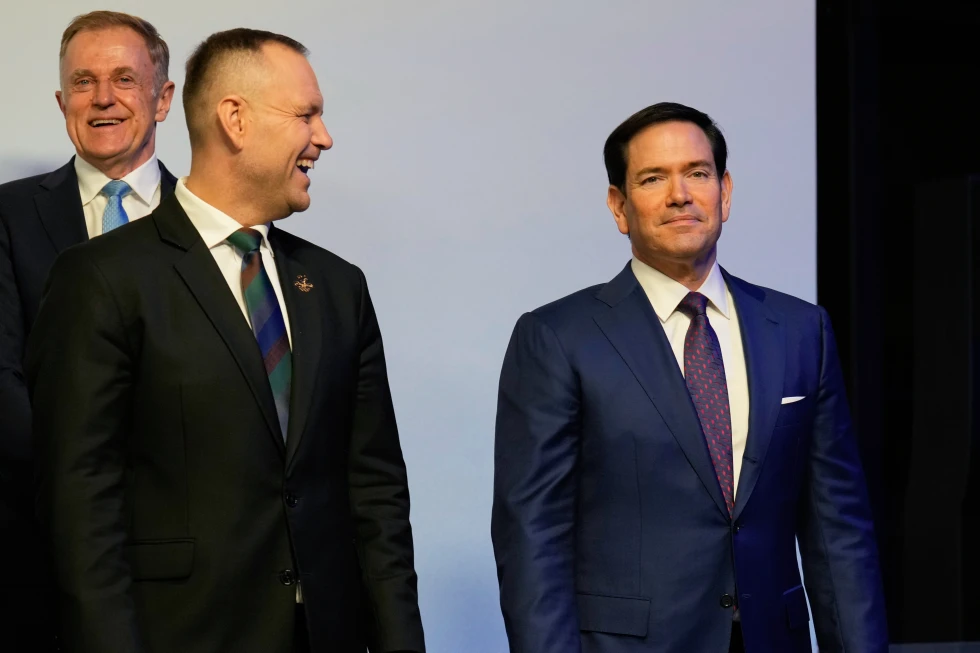
WASHINGTON — Secretary of State Marco Rubio is on his latest mission to reassure anxious U.S. friends in Europe about the Trump administration’s intentions with NATO, or at least put a nicer face on whipsawing shifts and uncertainties regarding American troop cutbacks.
Rubio will attend a NATO foreign ministers’ conference in Sweden on Friday, the same day that senior Pentagon officials are due to inform the 32-nation alliance at its Brussels headquarters on preparations for the commitment of the U.S. military to European defense.
The gathering of diplomats, prior to a NATO leaders’ summit in Turkey in July, comes with the war in Iran unpredictable and efforts by the U.S. to mediate an end to the Russia-Ukraine conflict in limbo. Resentment also still boils over on the continent over President Donald Trump’s bashing of allies and his interest in taking over Greenland, a province of NATO member Denmark.
Rubio has often been asked to convey a more measured, less combative side of the Trump administration at such talks. He has been sent on numerous similar missions this year, including the Munich Security Conference in February and more recently to Italy where he met with Italian officials and Pope Leo XIV after Trump attacked the American pontiff for his views on crime and the Iran conflict.
Ambiguity over US army withdrawals in Europe On his way to the meeting in Helsingborg, Sweden, Rubio would not speculate on any other changes to the U.S. military presence in Europe, including a possible reduction in the number of troops the U.S. will contribute under the NATO Force Model, a contingency plan for European defense in case of serious security concerns.
The Trump administration had planned to scrap plans to deploy thousands of U.S. troops to Poland and Germany, but the president tweeted Thursday that “the United States will be sending an additional 5,000 Troops to Poland.”
It was unclear if it meant the brigade that had been prevented from heading to Poland would be on its way, if additional troops beyond that rotational deployment could be deployed, or if there still would be a drawdown of U.S. troops in Europe, but from a different country. Requests for comment were referred to the White House, which did not immediately return messages requesting clarification.
Rubio did say earlier that Trump and others in the administration, including him, are “very disappointed” in NATO, notably in its response to the Iran conflict.
“I don’t think anyone is surprised to hear that the United States and the president, in particular, is very disappointed with NATO right now,” he told reporters in Miami before boarding his jet.
Rubio renews criticism of NATO over Iran war Rubio said he was a “strong supporter” of the transatlantic military cooperation and termed it “important”. But he repeated complaints that some NATO allies, notably Spain, had refused to allow access to U.S. bases for the Iran conflict and others had been reluctant, if not resistant, to join a coalition to reopen and protect the Strait of Hormuz, a crucial oil shipping route that Iran largely has closed.
“I understand why NATO is good for Europe, but why is it good for America? “Bases that allow us and others to project power around the world, right?” Rubio said, answering his own rhetorical question. “So when that’s the key rationale for why you’re in NATO, and then you have countries like Spain denying us the use of these bases, well then, why are you in NATO?”
Almost all NATO members believe that Iran should not be allowed to obtain nuclear weapons, but few, if any, stepped up when Trump stated he would act to prevent it, Rubio said.
He is not asking them to send soldiers. He’s not asking them to send in their fighter planes. But they’re not going to do anything and so I believe the president looks at that and thinks, ‘Hold on a second,’” Rubio said. ‘That I think upset us a lot. The president has been quite clear on that.”
NATO officials downplayed the reductions to U.S. troop levels in Europe, saying they had been long planned and are no surprise.
But the announcements have surprised some allies and occurred despite U.S. assurances to coordinate military movements to avoid creating security gaps. Similarly, Trump’s apparent reversal on Poland was another surprise.
U.S. allies have known for a year that the Trump administration would be withdrawing some troops from Europe, NATO Secretary-General Mark Rutte said Wednesday, and it expects “rightly, for Europe and Canada to take a bigger responsibility for the conventional defense of NATO and particularly, of course, the European part of NATO.”
Rutte said the U.S. “will stay involved” but may shift resources elsewhere in the world over time. U.S. Gen. Alexus Grynkewich, the top American and NATO commander in Europe, said this week that security on the continent wouldn’t be sacrificed, but warned partners to expect significant drawdowns in the years ahead.
The Trump administration has threatened Europe with having to provide its own security in future, including for Ukraine.